
NEWS CENTER
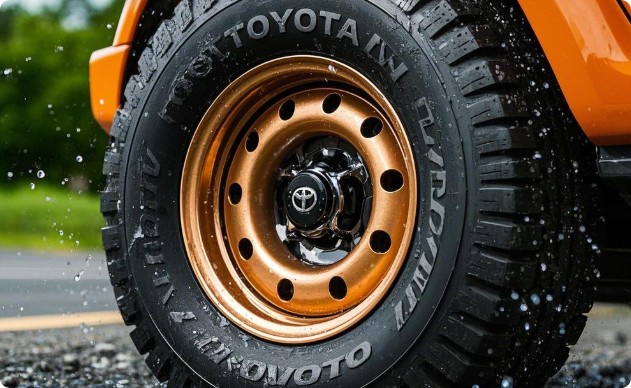
In the fields of modern automotive engineering and tire research and development, tires—being the only point of contact between the vehicle and the road—play a crucial role in vehicle safety, handling, and fuel efficiency.
The design and optimization of tires involve multiple key factors, among which tread pattern, tire pressure distribution, and material properties have a decisive impact on overall performance. To thoroughly study the influence of these factors on tire performance, engineers widely employ pressure-sensitive paper testing technology to obtain precise tire contact patches. This enables the analysis of pressure distribution characteristics and further optimization of tire design.

Xiaomi SU7 Ultra PT01 Track High-Performance Tire @ Sailun Group
Tire tread pattern is one of the core factors determining tire performance. Different tread designs affect the tire's grip, drainage capability, noise level, and wear resistance.
Typically, tire tread patterns are categorized into symmetric, asymmetric, and directional patterns, each optimized for specific driving needs. For instance, symmetric patterns are widely used in family cars due to their balanced performance, while asymmetric patterns can provide varying performance on both wet and dry surfaces, making them suitable for high-performance vehicles.
Additionally, directional patterns enhance drainage through specially designed V-shaped grooves, improving their resistance to hydroplaning on wet roads. However, optimizing tread design involves more than just morphological changes—it also requires precise analysis of pressure distribution to ensure the tire's actual contact characteristics align with expectations.
@AutoKnowledgeHub
Uneven tire contact pressure distribution may lead to accelerated localized wear, thereby shortening the tire's service life and potentially causing safety hazards such as blowouts.
Furthermore, pressure distribution significantly impacts fuel economy. During vehicle operation, the tire contact area and contact pressure determine rolling resistance, which is directly related to fuel consumption. Therefore, optimizing tire pressure distribution not only enhances driving safety but also reduces fuel consumption and improves economic efficiency. Traditional pressure testing methods often rely on theoretical calculations or finite element simulations, whereas the application of pressure-sensitive paper testing technology provides engineers with an intuitive and precise means of measuring pressure distribution.
Pressure-sensitive paper, as a tool for accurately recording pressure distribution, plays a significant role in automotive engineering and tire research and development. Also known as "pressure-sensitive paper" or "pressure-sensing paper," it is an electronic functional material that precisely measures pressure distribution, magnitude, and balance, as well as the flatness and sealing of product joints through chromogenic density. It is widely applicable in fields such as liquid crystal displays, semiconductors, electronic circuits, automotive manufacturing, and mechanical equipment production and inspection.
Under a microscope, pigment particles attached to the donor substrate are adsorbed onto the chemically treated surface of the receiver paper. The receiver paper and the donor coating form a donor step. The chemical reaction between the donor paper and the receiver paper enables molecular diffusion between the two layers, resulting in network penetration from the pigment donor paper to the receiver coating. When an attempt is made to separate the donor paper from the receiver paper, the micro-shear forces between them cause the micro-particles to detach from the colored donor paper, leaving marks.
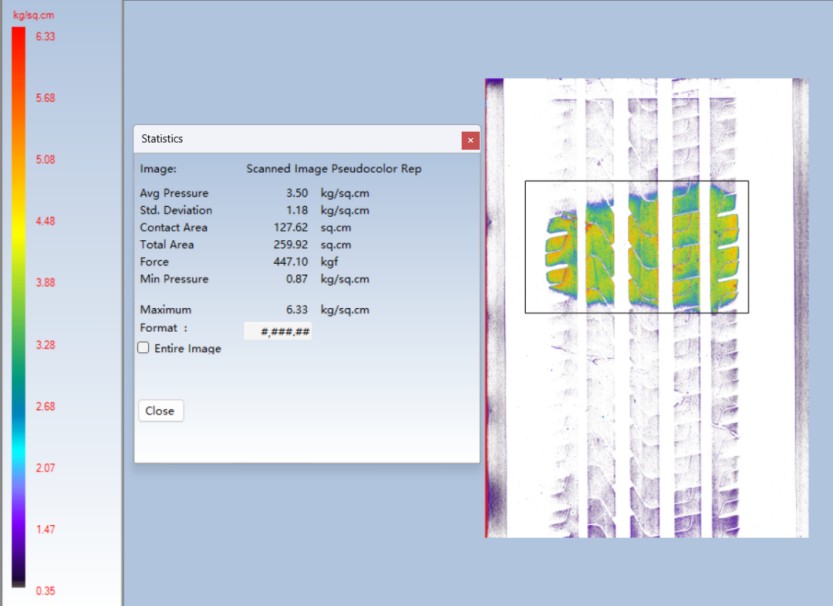
Taking PressureFilms pressure-sensitive paper as an example, its color changes or numerical feedback can visually display the pressure distribution when the tire contacts the ground, quantifying pressure differences across various areas. This helps evaluate the uniformity of tire-ground contact, preventing abnormal wear caused by localized excessive pressure.
Testing pressure distribution changes under different tire pressures helps determine the optimal pressure range to balance comfort, grip, and tire lifespan. By analyzing dynamic characteristics of contact area and pressure distribution, tire grip performance and handling stability can be indirectly evaluated, particularly under various road conditions (such as wet or icy surfaces).
In tire manufacturing, pressure-sensitive paper can detect pressure distribution abnormalities caused by defects (like tire body deformation or material inconsistency), ensuring dynamic balance and smooth driving. Areas with concentrated pressure typically wear out faster; PressureFilms data can predict tire wear trends, optimizing tread pattern design or material formulas to extend service life. Simulating pressure distribution under different load conditions verifies whether the tire maintains reasonable contact characteristics under rated loads.
The PressureFilms pressure-sensitive paper and its analysis system provide support for tire design and development. By testing the contact characteristics of different tread patterns or rubber formulas, it assists in designing more energy-efficient, quieter, or higher-grip tires. Additionally, it supplies real-world data for computer simulations (such as finite element analysis), enhancing the accuracy of virtual testing.

PressureFilms pressure-sensitive paper offers significant technical advantages: high resolution captures subtle pressure changes, revealing details difficult to observe with traditional methods; user-friendly operation requires no complex equipment, suitable for both laboratory and field testing; data visualization generates color pressure maps for quick interpretation and comparison.
In the field of automotive engineering, PressureFilms pressure-sensitive paper is not only used for tire imprint tests but also widely applied in areas such as automotive suspension systems, braking systems, and body rigidity analysis. For example, during brake system optimization, engineers can use pressure-sensitive paper to test the contact between brake pads and discs, ensuring even contact under force, improving brake force distribution uniformity, and thereby enhancing the vehicle's braking performance.
Meanwhile, in suspension system optimization, pressure-sensitive paper can detect the stress on wheel load-bearing components to determine whether adjustments to the suspension structure or more rational material configurations are needed. For body rigidity, engineers can test pressure distribution at body connection points using pressure-sensitive paper, optimizing welding processes or reinforcing key structural areas to improve the vehicle's durability and safety.
In summary, pressure-sensitive paper testing provides critical data support for tire design, manufacturing, and performance optimization, serving as an important tool for enhancing vehicle safety and energy efficiency.
With continuous advancements in testing technology, future pressure-sensitive paper testing methods will deeply integrate with intelligent and digital technologies, providing more precise and efficient solutions for the automotive industry's development. In the ongoing pursuit of safety, economy, and performance optimization in the automotive industry, pressure-sensitive paper testing technology will continue to play a vital role, driving automotive engineering toward higher levels of development.
Recent Post
![]() Sep 30, 2026PF invites you to attend ICMMB 2026, the 24th International Conference on Medical and Biological Mechanics (Oct. 6–8).
Sep 30, 2026PF invites you to attend ICMMB 2026, the 24th International Conference on Medical and Biological Mechanics (Oct. 6–8). Jun 18, 2026Focus on Plantar Pressure Distribution | Technical Applications of the Pressurefilms Insole‑Type Flexible Fabric Pressure Distribution System
") May 21, 2026Invitation丨PRESSURE FILMS INTERNATIONAL LIMITED Invites You to the 2nd Vietnam International Electronics Industry & Smart Manufacturing Expo 2026 (VIEE2026)
May 21, 2026Invitation丨PRESSURE FILMS INTERNATIONAL LIMITED Invites You to the 2nd Vietnam International Electronics Industry & Smart Manufacturing Expo 2026 (VIEE2026) May 21, 2026From Vector Sensing to Multi-Dimensional Decision-Making | A Full-Field Application Analysis of PressureFilms High-Precision 3D Force Plates

Contact Us
Derect Contact with us